
We were in a partner meeting last month where someone said, almost as an aside: "Content is cheap now. What matters is whether your system can expose it to everything that needs to consume it."
Nobody argued. And nobody could quite explain why their CMS made the cut for that job.
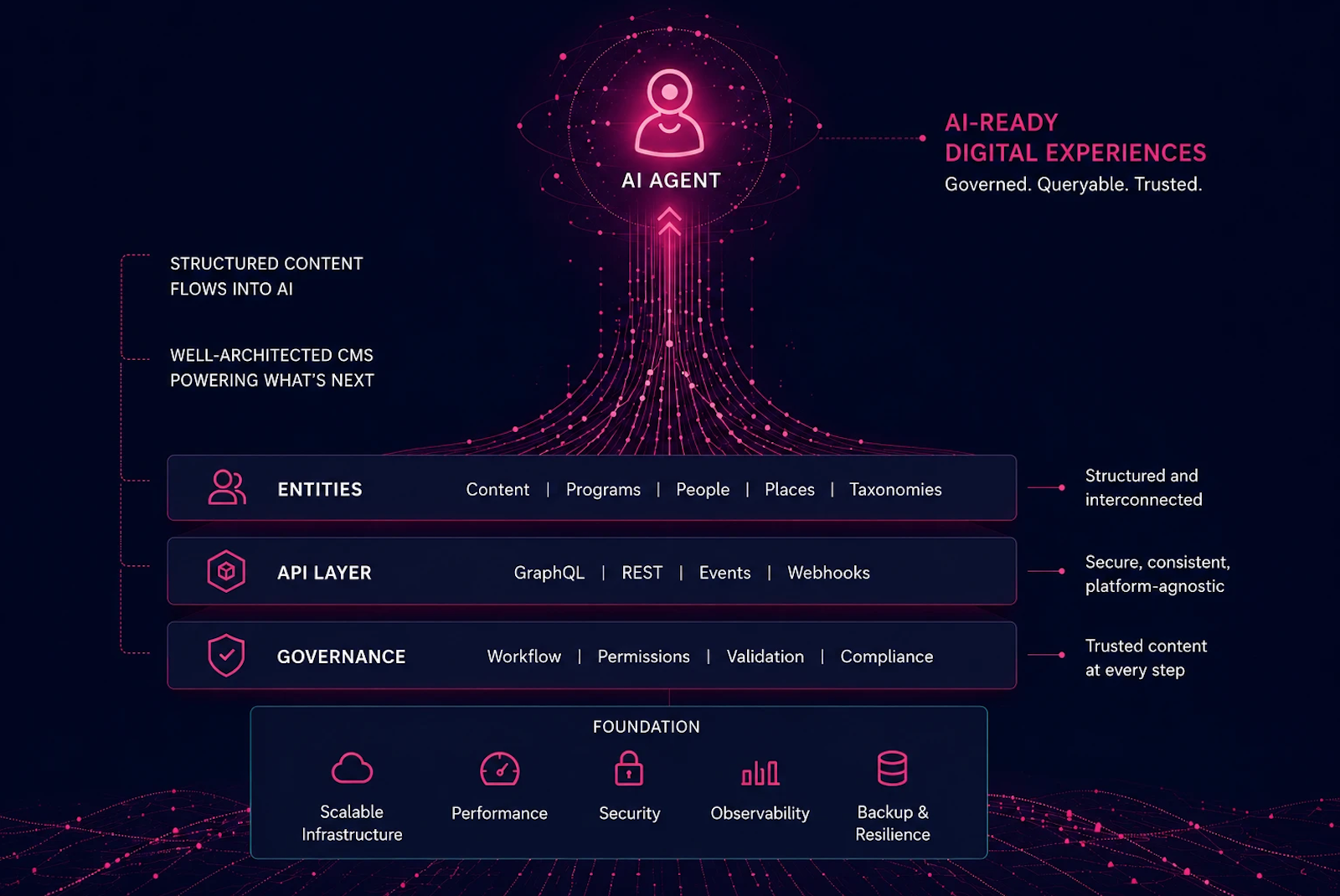
Most CMS decisions get made on publishing criteria: editor experience, time to launch, licensing cost. And those things still matter. What most evaluation teams haven't added to the scorecard is whether their platform can describe itself to an AI agent. That's a specific technical ask, and most platforms weren't built to answer it. A browser renders a page for a human. An agent queries for structured data, traverses relationships between entities, checks permissions, and needs to understand the shape of a content system before it can do anything useful with it.
The Shift That's Already Happened
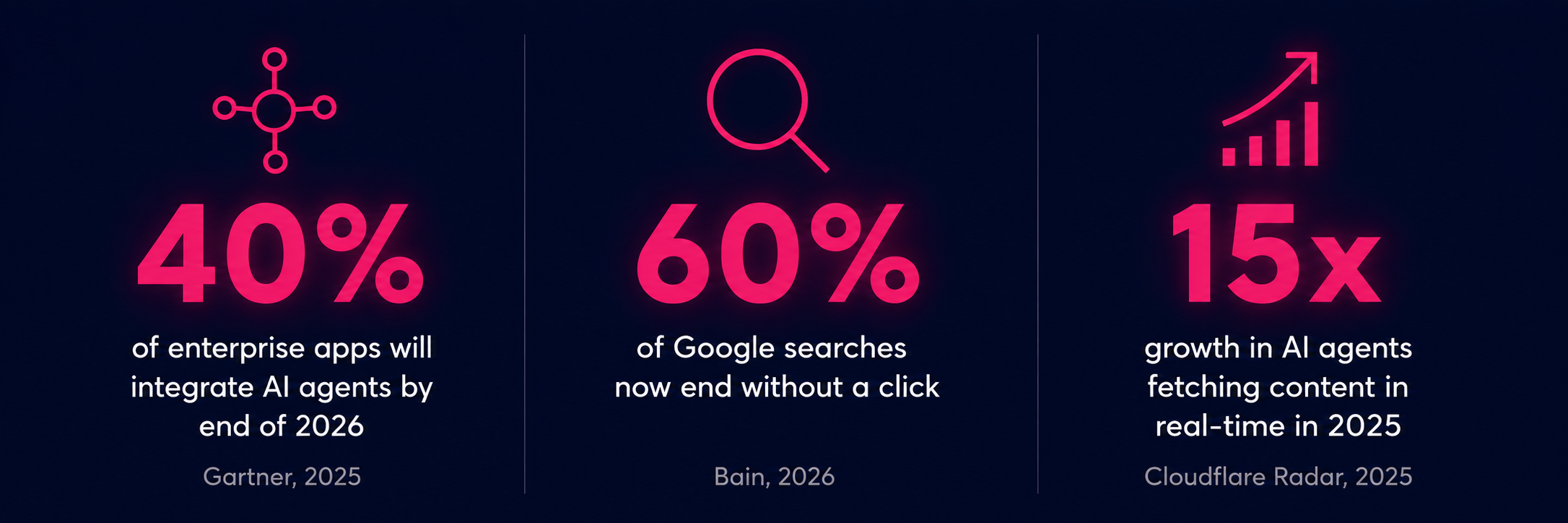
Gartner predicts 40% of enterprise applications will be integrated with task-specific AI agents by end of 2026, up from less than 5% in 2025. McKinsey's 2025 State of AI survey found 62% of organizations are at least piloting agentic AI somewhere in their operations. And Cloudflare's 2025 Year in Review logged something harder to ignore: AI user-action crawling, bots fetching content in real-time on a user's behalf, grew more than 15 times over the course of 2025 alone. That's not training data collection. Those are agents working for real users right now, at scale.
On the consumer side, the numbers from 2026 are sharper than any forecast. Sixty percent of Google searches end without a click, per Bain's analysis. When Google's AI Mode is active, available to all U.S. users since March 2026, that number reaches 93%. Seer Interactive analyzed 5.47 million tracked queries through February 2026 and found organic click-through rates dropped 61% on queries where AI Overviews appeared.
Your content is being read, synthesized, and delivered to people who never visit your site. Whether AI systems represent it accurately depends entirely on whether your content infrastructure gives them something real to work with.
What AI Actually Needs
"API support" and "AI-ready" are not the same thing. Almost every enterprise CMS has some kind of API, and that stopped being a differentiator a while ago.
What agents need goes deeper. They need a system that describes its own structure: the relationships between content types, the taxonomy that organizes them, the permissions that govern access. They need entities, not pages. A page is a rendered document. An entity is a structured object with defined fields, typed relationships, and queryable metadata. When an agent is reasoning about a content system rather than retrieving a document, that distinction carries real weight.
Governance has to live in the foundation. When AI makes changes, or when content gets published based on an AI recommendation, there needs to be an audit trail, a workflow state, a rollback path. Gartner's June 2025 research puts the stakes plainly: over 40% of agentic AI projects will be canceled by end of 2027, with inadequate risk controls as a primary reason. The projects that survive won't have the best models. They'll have the most reliable infrastructure underneath them.
Drupal's Architecture and Why It Fits
The architectural decisions that made Drupal 8 painful to adopt turned out to be exactly what AI-native integration requires. The Entity API, JSON:API in core, configuration management, content moderation workflows, granular permissions: these came from the governance and scale demands of complex government and enterprise clients. Nobody designed them for AI. But the requirements that shaped them, audit depth, structured relationships, granular permissions, reproducible deployments, are the same requirements AI-native workflows now depend on.
An AI agent querying a well-built Drupal site gets more than pages. It gets a structured representation of a content domain: who published what, in what workflow state, with what relationships to adjacent content, under what permissions. Users, taxonomy terms, media assets, and custom content types are all first-class entities with field-level APIs. That's not a retrofit. It's how the platform was built.
JSON:API ships in Drupal core. GraphQL support is available. Configuration management makes deployments reproducible and auditable, which matters for any AI-assisted workflow where knowing exactly what was in place when a content decision was made is part of the record. MCP (Model Context Protocol) support is in active development, letting Drupal function as a structured data source for external AI agent ecosystems.
The community investment behind this is worth knowing. The Drupal AI Initiative reached a stable 1.2.0 module release in October 2025, built by 127 contributors across 64 organizations, with over 60 new features including an AI Observability module and Prompt Library. By February 2026 the initiative had grown to 28 sponsoring organizations, $1.5 million in combined resources, and over 50 active contributors. The 2026 roadmap covers page generation, context management, background agents, advanced governance, and site improvement driven by performance data.
The bet isn't limited to the open-source community. Acquia, the world's largest Drupal hosting provider, announced Acquia Source in April 2026 as a unified platform for content, AI agents, and governance built on Drupal as the structural foundation. Acquia's chief product officer described the platform as extending existing governance models to AI systems, so automated processes operate within defined roles and permissions. When the leading commercial platform in the Drupal ecosystem decides AI agents need to live inside a governance architecture rather than alongside it, the market is saying something.
One of our federal clients operates a public information platform that serves millions of visitors during peak civic engagement periods, the kind of traffic that doubles and redoubles in a matter of weeks based on events nobody can predict. The platform runs on Drupal. When the team decided to add AI-powered search, the structured content architecture that had been in place for years became the foundation. Data across thousands of programmatically generated pages, each with defined fields, typed relationships, and consistent taxonomy, gave the AI search layer something real to work with. The search experience isn't querying unstructured HTML. It's traversing a content model. That capability came from how the platform was built, not from anything added after the fact.
A state and local government client we support tells a similar story from a different angle. The goal was a conversational assistant that could help residents find services without navigating a complex site structure. The chatbot was built on top of Drupal's content governance layer. Role-based access controls, content moderation states, and structured service taxonomies meant the AI agent was constrained by the same rules as every content editor. It couldn't surface unpublished content, couldn't bypass workflow states, couldn't expose anything the governance model hadn't cleared. That work was recognized as a 2026 Acquia Engage Award finalist for Best Transformation for Security and AI Readiness, a category defined around replacing fragmented systems with unified platforms where security and compliance are non-negotiable prerequisites for Drupal AI readiness.
The AI capability in both cases was made possible, and made safe, by content architecture decisions that predated any AI conversation.
How the Alternatives Stack Up
The right platform depends on your organization, and each of these has real strengths. A fair read matters.
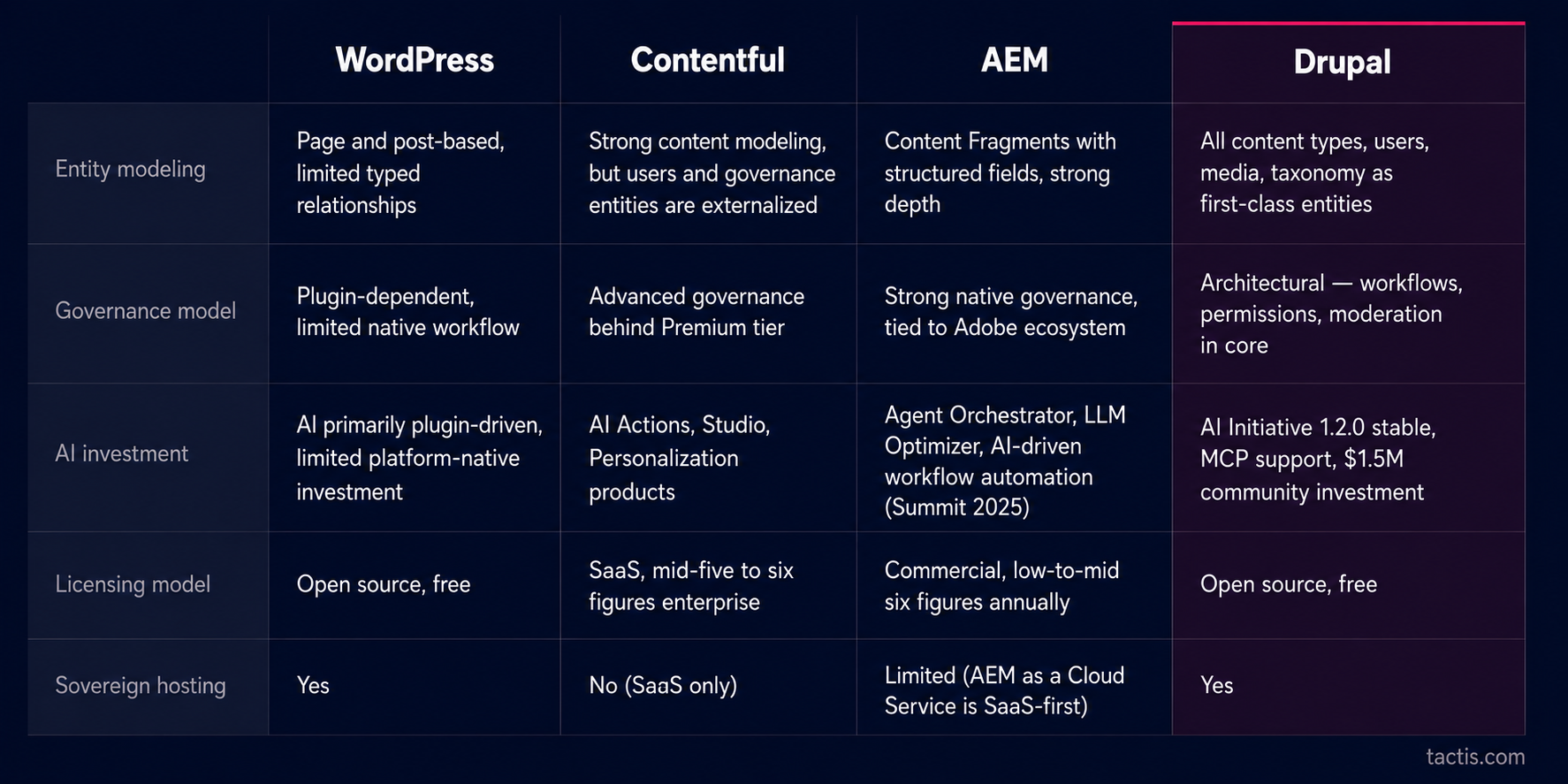
WordPress dominates deployment volume for good reason. For many use cases it's the right answer. The constraint is architectural: WordPress's REST API retrofits structured output onto a platform built around rendered HTML. Complex content relationships, custom permission structures, and taxonomy depth require plugin layers that compound over time. For a team wanting a fast headless setup without deep governance requirements, that's often a reasonable tradeoff. For organizations that need AI-assisted content operations with full auditability, the gap is real.
Contentful is API-first from day one. Content reaches any front-end efficiently and the developer experience is clean. The narrower part of the story is entity modeling. Contentful handles "Content" well, but users, media, and taxonomy aren't first-class entities with the same relationship depth. Advanced governance, custom roles, workflows, and SSO, lives behind the Premium tier. Vendr's 2026 pricing data puts enterprise Contentful contracts in the mid-five to six-figure range annually. For organizations running modern front-end frameworks on a managed cloud setup, Contentful makes sense. For regulated environments that need sovereign hosting or governance at the architectural level, the tier structure creates friction.
AEM is a different conversation entirely. Adobe's AI investment is serious: Site Optimizer, LLM Optimizer, agentic content workflows from Adobe Summit 2025. Content Fragments and GraphQL give it real structured-content depth, and Gartner named it a Leader in the 2025 Digital Experience Platform Magic Quadrant. For organizations already running Adobe Analytics, Target, and Assets, the integration story is legitimate and the governance is solid.
What independent agency analyses consistently show is that AEM licensing runs in the low-to-mid six figures annually before implementation, with full enterprise deployments often reaching $500,000 to $1 million or more (40Q Agency, Clear Digital, 2026). For federal agencies and healthcare systems evaluating whether Adobe ecosystem entry cost is justified for the structured-content layer they need, that number is worth knowing. Drupal provides the same structured-content layer without the licensing entry cost.
Why Federal and Healthcare Organizations Should Pay Attention Now
For most commercial organizations, structured content governance is a quality consideration. For federal agencies and health systems, it's statute.
The HIPAA Security Rule (45 CFR 164.312(b)) requires audit controls on systems that contain or interact with electronic protected health information: hardware, software, and procedural mechanisms that record and examine activity. When AI is involved in content creation or routing in a healthcare environment, a traceable record of what it did, when, and on what basis is a legal requirement, not an IT preference. OMB M-25-21 extends comparable requirements to federal AI systems classified as high-impact, those affecting health and safety.
Prompt injection attacks are documented and growing. A malicious actor embeds instructions in content that an AI agent reads, and the agent executes them, sometimes exposing data it was never meant to access. The Centers for Medicare and Medicaid Services' own 2026 AI technical reference flags this directly: attackers can steal sensitive data by manipulating prompts or exploiting vulnerabilities in AI systems connected to content infrastructure. A bolt-on AI tool sitting above your CMS with its own API connections has no knowledge of your content governance model. It operates outside the permission structure, the audit trail, and the moderation workflow entirely. When AI operates inside Drupal's editorial architecture, it's subject to the same role-based access controls and content moderation states as any human editor on the system. The Drupal Security Team, one of the first dedicated security teams in any open-source CMS project, publishes advisories on a predictable weekly cadence through a transparent ten-stage patch process. For regulated environments, that predictability matters. You can build a compliance posture around it.
The 21st Century IDEA Act requires federal agency websites to meet GSA's published digital service standards. Structured, accessible, governable content is the legal baseline. Drupal already underpins a significant portion of the federal digital estate: the Centers for Medicare and Medicaid Services, Treasury, IRS, NOAA, the Social Security Administration, HHS, DHS, and USA.gov, which indexes more than 1,800 federal websites. Those agencies didn't choose Drupal because it was easy. The governance model held up under federal scrutiny, and that matters when AI enters the workflow.
The Compounding Investment
Organizations that built clean Drupal architecture, solid entity models, governed workflows, proper JSON:API implementation, are in a better position than they probably expected. The structural work done for content governance turns out to be exactly what AI agents need. No rebuilding required.
Organizations that chose lighter platforms for faster initial deployment, or that deferred the structure work, are facing a harder question. Not whether they can deploy AI, but whether their content infrastructure can support it reliably without becoming a liability.
Sixty percent of searches now end without users visiting any source. Organic click-through rates dropped 61% on queries where AI Overviews appeared, and Google's AI Mode produces a 93% zero-click rate for users who activate it (Seer Interactive, 2026). The audience that used to find your content by clicking a link is now getting answers from a system that never visits your site. What that system knows about you, and how accurately it represents you, depends on what your CMS has exposed for it to learn from.
The organizations that did the architecture work early are compounding it now. The ones still figuring it out are doing it under pressure they didn't expect.
Tactis has been building and maintaining Drupal platforms for federal agencies, health organizations, and mission-driven clients for over two decades. The AI work our teams are doing now, intelligent search on top of structured federal content, conversational assistants embedded in governed Drupal architectures, data pipelines that make government information accessible to plain-language queries, isn't a new practice area. It's the next layer on platforms we already know well. When you're evaluating what AI-readiness actually requires from your content infrastructure, that combination of platform depth and active AI delivery changes the conversation.
Tactis helps federal agencies, health systems, and mission-driven organizations build digital experiences that hold up under real requirements. If you're working through CMS strategy in the context of AI readiness, we'd like to have that conversation. Contact us.